
Queen Anne Revival is a specific style within the broader Victorian architectural landscape. Queen Anne Style Architecture emerged as one of the prominent expressions of the revivalist spirit during the Victorian era, which was characterized by its long reign and diverse architectural trends. This period witnessed a revival of various historical styles, with Queen Anne Revival standing out for its distinctive architectural character and decorative approach.
Victorian Architecture (1837-1901) is not limited to any particular style but it relates to the reign of Queen Victoria called the Victorian Era. Although Queen Victoria reigned from 1837 to 1901, the Victorian styles were most popular in the second half of the nineteenth century. It is a series of revival architectural styles used in the Victorian Era in the mid-late 19th century. Revival styles include but are not limited to
- Gothic Revival
- Queen Anne Revival
- Renaissance Revival
- Romanesque Revival
- Scots Baronial
- Other transitional designs
What is Victorian Architecture?
Victorian architecture refers to the architectural styles that were prevalent during the reign of Queen Victoria of the United Kingdom, which lasted from 1837 to 1901. This period saw a diverse range of architectural styles, influenced by the Industrial Revolution, technological advancements, and a revival of interest in historical design elements.
What is Queen Anne Style?
The Queen Anne style is a decoratively rich style that typically features an asymmetrical composition combining a variety of architectural forms including porches, towers, turrets, gables, bays, chimneys and other projections. The exterior is further enlivened by contrasting surface textures, materials, and colors.
Characteristics of Queen Anne style Architecture
- Extravagantly picturesque
- Irregular plans and elevations are its hallmark
- lively and exuberant
- elements and forms can come from many styles to create a unique effect
- Variety of surfaces used on the same building, especially brick, wood shingles of different shapes, stucco and half-timbering
Key Features of Queen Anne ArchitectureThe main features of Queen Anne Architecture are
Exterior Features
- Asymmetrical plans and elevations
- Structures feature bays, turrets, towers, decorative chimneys, gabled or multi-gabled roofs and verandahs
- Red brick
- Differing wall textures (wood, brick, stone, terracotta)
- Wood shingles in various shapes
- Porch covering all or part of the front facade
- Non classical columns
- Bay windows
- White painted sash windows/curving bay windows/Oriel windows
- Delicate brick panels of sunflowers, swags, or cherubs, with small window panes
- Pedimented gables
- Steep roofs – roofs are usually steep and often multiple
- Wooden Balconies
Interior Features
- Windows: sash windows/Bay windows/leaded and stained glass
- Flooring: parquet/linoleum/floor cloths
- Fireplaces: glazed tiles/built-in-cupboards
- Staircases: stained glass in landing
Queen Anne Revival Examples
Carson Mansion (1884-1886)
- Building: Carson Mansion
- Function/Use: Grand home/Mansion
- Location: 143 M Street, Eureka, California
- Date of construction: 1884 – 1886
- Architect: Samuel Newsom, Joseph Cather, Newsom
- Historical Influence: Revival styles
- Key Features: eclectic design
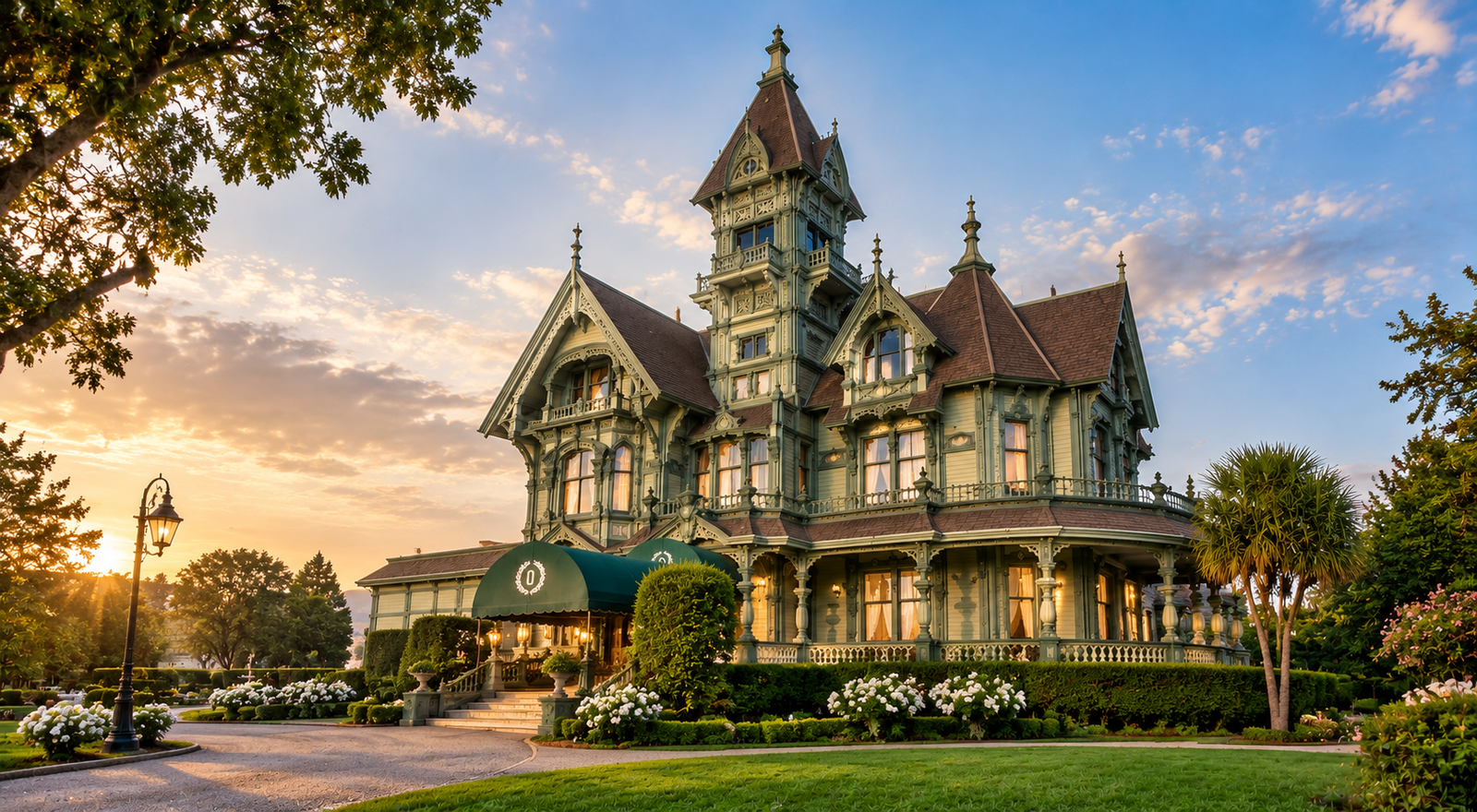
Structure and Facade
The house is “considered the grandest Victorian home in America. It is one of the fine examples of Victorian Architecture which is also a mix of various revival styles such as Queen Anne, Italianate, Eastlake, etc. One nationally known architectural historian described the house as “a baronial castle in Redwood…” and stated further that “The illusion of grandeur in the house is heightened by the play on scale, the use of fanciful detail and the handling of mass as separate volumes, topped by a lively roofscape. (from wiki)
Isaac Liscomb House (1885)
- Building: Isaac Liscomb House
- Function/Use: Grand home/Mansion
- Location: 67 Princeton Avenue, Providence, RI, USA
- Date of construction: 1885
Structure and Facade
The Isaac Liscomb House was properly restored and maintained well. It is a highly decorative house with a straightforward layout that is located in the prominent corner of the neighborhood. True to Queen Anne style, the Liscomb house exhibits layers of details and textures. With band of shingles between each floor, the facade comprises of horizontal wooden battens and windows alternatively and with a gabled roof above. At the entrance, a bay window and a porch welcomes visitors. Later in 1929, the house was carved into apartments with much of the original details retained.
Thomas Leavens House (1885)
- Building: Thomas Leavens House
- Function/Use: Grand home/Mansion
- Location: 55 Princeton Avenue, Providence, RI, USA
- Date of construction: 1885
- Architect: Thomas Gould and Frank Angell
Structure and Facade
The Leavens House presents itself as a quaint Queen Anne residence, modest in size when compared to the grandeur of the neighboring Colonial Revival homes. Elaborate bargeboards adorn the front and side gables, while a series of concentric rings adorns the structure in a decorative frieze.
Esther Hinckley Baker House (1882)
- Building: Esther Hinckley Baker House
- Function/Use: Grand home/Mansion
- Location: 179 Hope Street, Providence, RI, USA
- Date of construction: 1882
Structure and Facade
Esther Hinckley Baker House is one of the city’s most magnificent Queen Anne houses. Located in the corner of Manning and Hope Streets, the house presents a dramatic pavilion and offers two principal entrances, one for the pedestrians on Hope Street and other for vehicle on Manning street. Its facade is articulated with pink-mortar-dressed Seekonk-stone first story, grey-green slate-hung second story, red-slate roof, spindle-work porches, elaborately detailed gable ends, and pilaster-and-corbel chimneys.
Caerleon (1885)
- Building: Caerleon
- Function/Use: Historic house
- Location: Bellevue Hill, Sydney, Australia
- Date of construction: 1885
- Architect: Harry Kent, Maurice Adams
Structure and Facade
The house is a prime example of Queen Anne Style Architecture in Australia with its distinctive red brick walls, stone dressing, terracotta shingles, balconies, bay windows, verandas, leadlight windows, and intricate chimneys. It is known as the first Queen Anne home in Australia.
Mary L. & Frederick W. Hartwell House (1883-84)
- Building: Mary L. & Frederick W. Hartwell House
- Function/Use: Historic house
- Location: 77 Parade Street, Providence, RI, USA
- Date of construction: 1883-84
- Architect: Edward I. Nickerson
Structure and Facade
Mary L. & Frederick W. Hartwell House was designed by architect Edward I. Nickerson with dignified composition, interesting composition of walls and roofs as well as intelligent play of solids and voids, together with carefully controlled ornamentation. Its interior is arranged around a stair hall with a built-in bench and a coat rack. Also the stained glass windows and sunflower patters exhibit arts and crafts style architecture.
James Alldis House (1895)
- Building: James Alldis House
- Function/Use: Historic house
- Location: 355 Prospect St., Torrington, Connecticut
- Date of construction: 1895
- Architect: Edward I. Nickerson
Structure and Facade
James Alldis House is a well-preserved Queen Anne Style Architecture, featuring an irregular plan and massing, a round tower with a conical roof, an elaborate porch of sawn and turned woodwork, and intricate details throughout the exterior. The house showcases a variety of window designs and surface textures, typical of the Queen Anne style.
West Maling (1889)
- Building: West Mailing
- Function/Use: former residence and now ecclesiastical centre and administration building
- Location: Georges River Council, New South Wales, Australia.
- Date of construction: 1889
- Architect: Richard Norman Shaw
Structure and Facade
West Mailing house was constructed on a hill in Penshurst, offering a commanding view over Botany Bay. It stands out among the red brick mansions of Sydney’s late Victorian period due to its Federation Queen Anne style and exceptional architectural detail.
Constructed using warm bricks in a pattern called English bond, this is a very attractive two-story house. It has steeply sloped slate roofs, decorative brick chimneys, stained glass windows, and Tudor-style wooden strips. The ends of the roof are made of timber and plaster. The verandah has wooden posts with decorative brackets, and the tall chimneys stand out against the high gabled roof. One can enter the house through a large front door made of cedar, set into a sandstone arch with Gothic flutings.
The porch is decorated with mosaic art. The interior doors are between three and four inches thick and have arched tops set into inverted arch architraves, which are said to look more Medieval than Elizabethan. There are also a pair of stained-glass Inglenook windows that date the building to AD 1889.
Newton D. Arnold House (1888)
- Building: Newton D. Arnold House
- Function/Use: Historic house
- Location: 24 Stimson Avenue, Providence, RI, USA,
- Date of construction: 1898
- Architect: Edward I. Nickerson
Structure and Facade
This is a large Queen Anne house designed by Nickerson. It has traditional layout but modern Queen Anne decorations, popular in the late 1880s. The dining room and front parlor have elaborate two-story mantels. The parlor is now larger and includes space from a former wraparound front porch.
Amy T. & C. Franklin Nugent House
- Building: Amy T. & C. Franklin Nugent House
- Function/Use: Historic house
- Location: 67 Orchard Avenue, Providence, RI, USA
- Date of construction: 1888
- Architect: Hoppin and Ely
Structure and Facade
Hoppin & Ely’s design for the Nugents’ house at number 67 is a mix of different styles, including French chateau, English Gothic, and Chinese Chippendale, all combined with a Queen Anne style.
Conclusion
The Queen Anne Revival architecture, born out of a desire to revive the charm of an earlier era, has left an indelible mark on the architectural landscape. Its distinctive features, including asymmetry, decorative elements, and picturesque quality, have shaped the way we perceive and appreciate buildings. Beyond its historical significance, the movement’s influence has transcended borders, finding expression in diverse architectural styles around the world.
Frequently Asked Questions
Queen Anne Style Architecture is known for asymmetrical façades, varied rooflines, decorative details, projecting windows, towers, and a mix of textures. These features can help distinguish it from other Victorian styles.
Common features include steeply pitched roofs, irregular floor plans, bay windows, turrets, decorative woodwork, patterned brickwork, spindlework, and contrasting materials. Recognizing these elements makes it easier to identify the style.
Not exactly. Victorian architecture refers to a broad period and collection of architectural styles, while Queen Anne is a specific style that developed within the wider Victorian architectural movement.
A major reason is its eclectic nature. Designers combined elements from different historical traditions, materials, colours, textures, and decorative forms, resulting in buildings with highly varied appearances.
The Arch Space provides architecture-focused resources covering historical styles, design concepts, building features, and architectural examples, making it useful for readers comparing different architectural styles.
Ready to Take the Next Step?
Go beyond textbooks with courses designed to build subject knowledge, strengthen logical thinking, and develop problem-solving skills. Explore our courses and take the next step toward academic growth and excellence.





Leave a Reply