
Gothic Revival is a specific style within the broader Victorian architectural landscape. The Victorian era, characterized by its long reign and diverse architectural trends, witnessed a revival of various historical styles, and the Gothic Revival was one of the prominent expressions of this revivalist spirit.
Victorian Architecture (1837-1901) is not limited to any particular style but it relates to the reign of Queen Victoria called the Victorian Era. Although Queen Victoria reigned from 1837 to 1901, the Victorian styles were most popular in the second half of the nineteenth century. It is a series of revival architectural styles used in the Victorian Era in the mid-late 19th century. Revival styles include but are not limited to
- Gothic Revival
- Queen Anne Revival
- Renaissance Revival
- Romanesque Revival
- Scots Baronial
- Other transitional designs
What is Gothic Revival Architecture
Gothic Revival architecture is an architectural style that emerged in the late 18th century and gained widespread popularity during the 19th century. It is characterized by a revival of medieval Gothic architectural elements and motifs, drawing inspiration from the cathedrals, churches, and castles of the Gothic period (12th to 16th centuries). The Gothic Revival was a reaction against the neoclassical styles that dominated the 18th century.
Key Features of Gothic Revival Architecture
- Vertically Emphasizing elements
- Lavishly decorated ornamentation
Elements of Gothic Revival Style
The Gothic Revival structures are lavishly decorated both from inside and out with roofs, spires, glass.
- Exteriors with Ploychrome Brickwork
- Conical Roofs/Steep-Pitched roofs
- Pointed Arches
- Ribbed vaults
- Thin Spires: Eye-catching, needle like spires were projecting from the roofs of the buildings.
- Niches: Niches were filled with statues, sometimes not.
- Gables: Gables adorned with richly decorated carvings of mosaic.
- Pinnacles
- Stained Glass and Leaded glass: Richly colored stained glass
- Multifoil ornament
Prominent Building Types of Gothic Revival
Public Buildings – Palaces/Town Halls
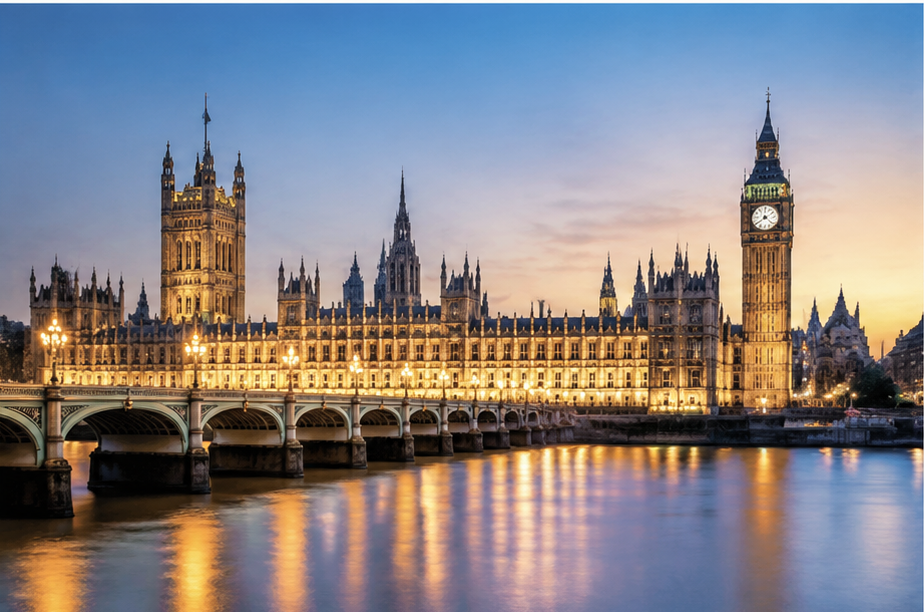
One of the most defining feature of Gothic Revival architecture in most of the public buildings is the use of pointed arches, which are often taller and slender. Towers and spires add to the vertical emphasis. Addition of elements such as Decorative parapets with crenellations and battlements give medieval fortress-like appearance.
Churches
Gothic Revival churches were not merely places of worship; they were architectural expressions of faith and a connection to a perceived medieval piety. The nave and aisles of these churches were designed to accommodate congregations on a grand scale, emphasizing communal worship. Stained glass windows, a hallmark of the Gothic Revival, became a canvas for religious narratives, with vibrant colors streaming into the interiors, creating an ethereal ambiance.
Country Villas and Houses
There are majorly six types of subtypes of Gothic revival houses. These are distinguished based on the roof form, floor plan and other details. 1. Centered Gable, 2. Paired gables, 3. Front gabled roof, 4. Asymmetrical, 5. Castellated or Parapeted, 6. Polychromed.
Marvelous Examples of Gothic Revival Architecture
Public Buildings
Palace of Westminster (1840 – 1876 (Rebuilt)
- Building: Palace of Westminster
- Function/Use: Parliament of the United Kingdom
- Location: North Bank of River Thames, Westminster, Central London, England
- Date of construction: 1840 – 1876 (Rebuilt)
- Architect: Charles Barry and Augustus Pugin
- Historical Influence: Gothic Architecture
- Key Features: Three main towers
- Materials Used: Limestone, cast-iron
- Universal Value: UNESCO World Heritage Site
Structure and Facade
The Palace of Westminster has three main towers – Victoria Tower (Southwest corner), Elizabeth Tower (north end), and Central Tower:
- Victoria Tower(98.5m high) – Victoria Tower is the largest and tallest secular building. At the base of the tower is the Sovereign’s Entrance. The 15m high archway is enriched with sculptures that include the statues of prominent figures, including that of Queen Victoria. At the top of the cast-iron pyramidal roof is a 22 m flagstaff.
- Elizabeth Tower (96m high) – Simply known as the clock tower, it houses the Great Clock of Westminster. The structure has largely become synonymous with Big- Ben, the heaviest of the five bells it houses.
- The central tower(91m high) – This octagonal central tower stands in the middle of the building above the central lobby. The slender form of the Central Tower, which was designed as a spire, markedly contrasts with the more massive square towers at the ends of the Palace.
Internally, the palace is a complex of passageways and has more than 1000rooms over four floors.
Victoria Building, University of Liverpool (1889-1892)
- Building: Victoria Building
- Function/Use: University of Liverpool
- Location: Liverpool, England
- Date of construction: 1889-1892
- Architect: Alfred Waterhouse
- Historical Influence: Gothic Architecture
- Key Features: clock tower with surrounding spires
- Materials Used: Ruabon brick, common brick, terracotta dressings, slate, concrete
Structure and Facade
In 1892, the Victoria building accommodated the administration, teaching, common rooms, and library. In 2008, it was converted into the Victoria Gallery and Museum, which houses art collections of paintings, sculptures, and ceramics as well as other exhibits related to various fields of study. It is an L-shaped building with three stories of 13 bays facing Brownlow Hill and five bays on Ashton Street.
Comprising alternate gables and gabled dormers in the southern eight bays; the ninth bay forms the highest tower that draws our eyes up towards the sky. The tower consists of all these elements, one above the other – an arched entrance, an oriel window, three-light windows, a royal coat of arms, a mosaic panel with an inscription and machicolation, and a four-faced clock. Buttresses rise to form pinnacles at each angle of the tower. The tenth bay has a staircase window and gable above, whereas the end bays curve around behind an octagonal tower with a spire.
Manchester Town Hall (1868-1877)
- Building: Manchester Town Hall
- Function/Use: Town hall
- Location: Manchester, England
- Date of construction: 1868-1877
- Architect: Alfred Waterhouse
- Historical Influence: Gothic Architecture
- Key Features: Clock tower and clock bell
- Materials Used: Bricks, timber, stonework, concrete, wrought iron beams
Structure and Facade
The Manchester Town Hall houses several local government departments. The building was designed to support practical technologies. It was planned to incorporate gas lighting and a warm-air heating system, which provided fresh air drawn from the inlets and admitted into the rooms.
The Manchester Town Hall is a typical example of the Victorian Gothic revival style of architecture, which includes themes and elements of 13th-century Gothic architecture such as rib vault ceilings and tall arched windows. Its façade is of uniform color and limited decoration; however, the exterior is decorated with statues of prominent figures of the city’s history. Moreover, the 85m high bell tower is the sixth tallest building in Manchester.
Churches of Gothic Revival Architecture
Basilica of Our Lady Immaculate (1876-1888)
- Building: Basilica of Our Lady Immaculate
- Function/Use: Roman Catholic
- Location: Guelph, Ontario, Canada.
- Date of construction: 1876-1888
- Architect: Joseph Connolly
- Historical Influence: Gothic Architecture
- Key Features: Twin towered facade
- Materials Used: Stone, brick, masonry, wood, stained glass
Structure and Facade
The Basilica of Our Lady Immaculate, situated in Guelph, Ontario, Canada, stands as an architectural masterpiece and a significant symbol of faith. Completed in 1888, this Gothic Revival basilica’s facade is adored with towering twin towers that appear as though reaching the sky, creating an awe-inspiring silhouette against the Canadian sky. These towers also create a commanding presence, whereas the central rose window radiates celestial beauty.
As one enters the basilica, the grandeur of Gothic architecture unfolds. Pointed arches, ribbed vaults, and intricate tracery define the interior, showcasing the meticulous attention to detail. Stained glass windows, bathed in hues of blues and reds, depict biblical scenes, enveloping the space in a transcendent glow. The soaring vaulted ceilings and flying buttresses contribute to a sense of divine elevation, fostering a spiritual ambiance within.
St Andrew’s Church (1904-1906)
- Building: St Andrew’s Church
- Function/Use: Anglican Church
- Location: 138 Nathan Road, Kowloon, Hong Kong, China
- Date of construction: 1904-1906
- Architect: Leigh & Orange
- Historical Influence: Gothic Architecture
- Key Features: Exposed brick exterior
- Materials Used: Red brick and granite
Structure and Facade
Laid in rammed earth construction, the building is built using red brick and granite. The bricks are exposed in the exterior walls that are pointed with a lime base mortar. The windows – the presence of stained glass in alters and baptismal windows, Art Nouveau style colored glass windows in the west and upper nave, as well as pictorial colored glass windows in the transept, all further complement the red brick façade.
St Colman’s Cathedral (1919)
- Building: St Colman’s Cathedral
- Architectural Style: Gothic Revival
- Function/Use: Roman Catholic Cathedral
- Location: Cathedral Place, Cobh, Ireland
- Date of construction: 1919
- Architect: George Ashlin & Edward Pugin
- Historical Influence: Gothic Architecture
- Key Features: Spire Cathedral
- Materials Used: Limestone, Portland stone, Granite, Slate
Structure and Facade
The church tower and shire being 91.4m high, is the tallest church in Ireland. The building is predominantly constructed of blue Dalkey granite with Mallow limestone dressings, while the foundation is erected by a large bed of sandstone.
Rose windows are perfectly set in the high pointed arches which are flanked by octagonal turrets both in the west front and the transepts. Pillars on the west front are constructed from granite. The octagonal spire of 90m is topped with a 3.3m bronze cross. The tower is made of Newry granite and houses 42 bells, wherein the combined weight equals 17 tons.
Country Villas and Houses
There are majorly six types of subtypes of Gothic revival houses. These are distinguished based on the roof form, floor plan and other details.
- Centered Gable
- Paired gables
- Front gabled roof
- Asymmetrical
- Castellated or Parapeted
- Polychromed.
Centered Gable
These are symmetrical houses with a prominent central cross gables above the central entrances. The plain of the central gable may be same as the front wall or projected forward. In few houses, smaller gables may be present either side of the central gables.
Paired Gables
As the name suggests, two gables are extended forward as projecting wings.
Front Gabled Roof
These are simple Gothic revival houses with narrow gable roofs so that the narrow gable ends makes up the front facade.
Asymmetrical
Asymmetrical plans have mostly L-shaped plans with cross gabled roofs. Gable dormers were commonly added to these roofs.
Castellated or Parapeted
This type of Gothic revival houses have either flat roofs with scalloped (castellated) parapets, or gabled roofs ending in high parapeted walls rather than overhanging eaves.
Polychromed
These Gothic revival houses show distinctive linear patterns in masonry wall surfaces. These decorative polychrome patterns are produced by bands of contrasting color or texture in the brick or stonework, and occur principally around windows and as horizontal bands on wall surfaces. It is sometimes treated as a separate style called High Victorian Gothic.
Conclusion
The Gothic Revival movement in architecture stands as a testament to humanity’s enduring fascination with the past. Through the lens of this revivalist style, architects sought not just to replicate but to reinterpret the grandeur and romance of the medieval era. Whether in public buildings, churches, or country villas, the Gothic Revival left an indelible mark on the architectural landscape, offering a bridge between the modern world and a romanticized medieval past.
Frequently Asked Questions
Gothic Revival Architecture is a 18th- and 19th-century architectural movement that revived elements of medieval Gothic design, including pointed arches, steep roofs, tracery, towers, and decorative ornamentation.
Key features include pointed arches, steeply pitched roofs, ribbed vaults, flying buttresses, stained-glass windows, ornate tracery, towers, spires, and detailed stonework.
The style gained popularity as architects and designers developed renewed interest in medieval architecture, craftsmanship, religion, history, and romantic ideas about the past.
Gothic Revival elements were widely used in churches, cathedrals, universities, government buildings, railway stations, libraries, and residential architecture.
Gothic Architecture originated during the medieval period, while Gothic Revival Architecture developed centuries later and deliberately reintroduced Gothic forms and decorative features into newer buildings.
Build Your Understanding of Architectural Styles
From Gothic Revival to Romanesque, Renaissance, and Modern Architecture, strengthen your understanding of the ideas, features, and principles behind major architectural styles. Take your architectural knowledge further with practical learning from The Arch Space.





Leave a Reply